


July is Luxury Month at Inman. We’ll take the temperature of the luxury market, talk to top producers in the ultra-luxury space and dive into the luxe trends of today — all culminating at Luxury Connect in San Diego, where we’ll announce this year’s Golden I Club honorees.
The dollar amount of U.S. residential real estate transactions by international buyers rose 33.2 percent year over year to $56 billion in existing homes from April 2024 through March 2025, the National Association of Realtors reported Monday.
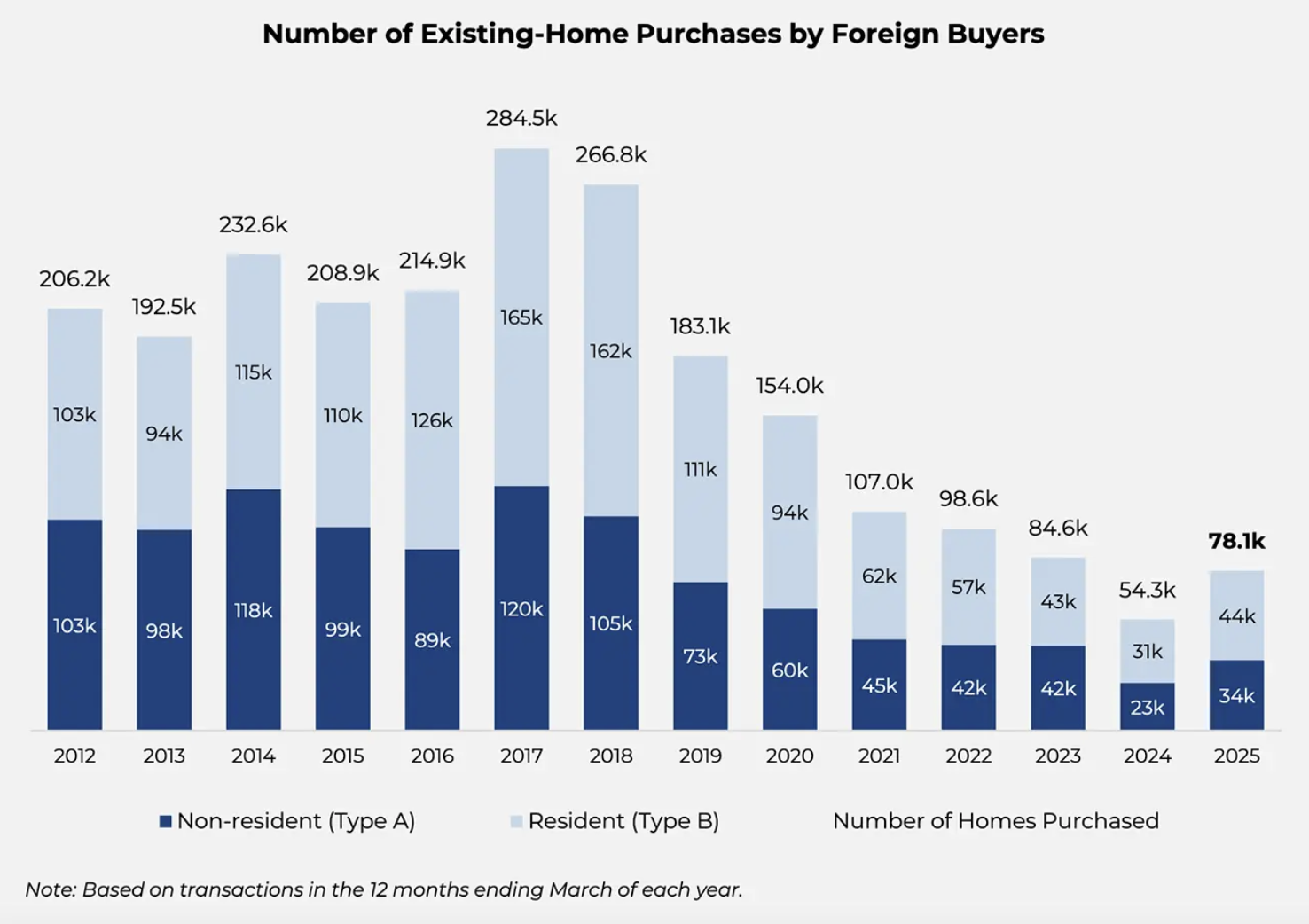
The number of properties purchased by those international buyers rose 44 percent year over year to 78,100 homes, the first annual increase in the number of transactions since 2017.
The median purchase price for international buyers also hit a new record high at $494,400, up from $475,000 the previous year, according to NAR’s 2025 International Transactions in U.S. Residential Real Estate report.
Credit: National Association of Realtors

Lawrence Yun | Chief economist at the National Association of Realtors
“International interest in buying U.S. real estate increased following the global economic recovery from several years of pandemic-related disruptions,” NAR Chief Economist Lawrence Yun said in a statement. “However, elevated home prices and interest rates continue to dampen overall potential sales activity and remain well below pre-pandemic levels.
“Boosted by a significant increase in the state’s housing inventory, Florida remained the top destination for foreign homebuyers, extending a streak of at least 15 years,” Yun continued. “To some degree, due to stubbornly high mortgage rates, a greater share of international homebuyers paid cash — 47 percent compared to 28 percent among all buyers — and they were more likely to purchase homes priced in the upper end of the market. Foreign buyers are drawn to investing in American real estate, in part, by our country’s strong protection of private property rights.”
Those international buyers who were living in the U.S. as new immigrants or were visa holders bought 43,700 homes (more than half of all international purchases) representing $26.9 billion.
Even though some Americans may view the U.S. as a slightly more volatile place to be right now, many internationals still view the U.S. as a stable place to invest, Yuval Golan, founder and CEO of foreign real estate investing platform Waltz, told Inman. Buyers from countries like Brazil, Colombia and Chile, where the political situations are seen as precarious, see the U.S. as a good place to park their money.
“Each market, whenever there’s any stability anywhere else, they want to bring their money in America, and with that, if there’s any crisis, it means the prices are discounted when their currencies are stronger, or when they feel like their political situation is not favorable, money will go into hard assets, which is U.S. real estate or gold. They bring that money to the U.S.,” Golan said.
States that are pro-business, like Florida and Texas, are also more attractive to those international buyers, Golan said, which is reflected in NAR’s report.
Where international buyers came from
China made up the largest number of foreign buyers in the last 12 months, flip-flopping with Canada from the previous year. Chinese buyers also have the highest average purchase price of homes at $1.2 million, NAR said.
By region, buyers from Asia made up the largest proportion of foreign buyers at 38 percent. Latin American buyers made up the second-largest share at 28 percent and European buyers made up 11 percent.
Top countries of origin
- China: 15 percent of foreign purchases, 11,7000 existing homes bought, $13.7 billion in sales volume
- Canada: 14 percent of foreign purchases, 10,900 existing homes bought, $6.2 billion in sales volume
- Mexico: 8 percent of foreign purchases, 6,200 existing homes bought, $4.4 billion in sales volume
- India: 6 percent of foreign purchases, 4,700 existing homes bought, $2.2 billion in sales volume
- United Kingdom: 4 percent of foreign purchases, 3,100 existing homes bought, $2 billion in sales volume
Where international buyers moved to
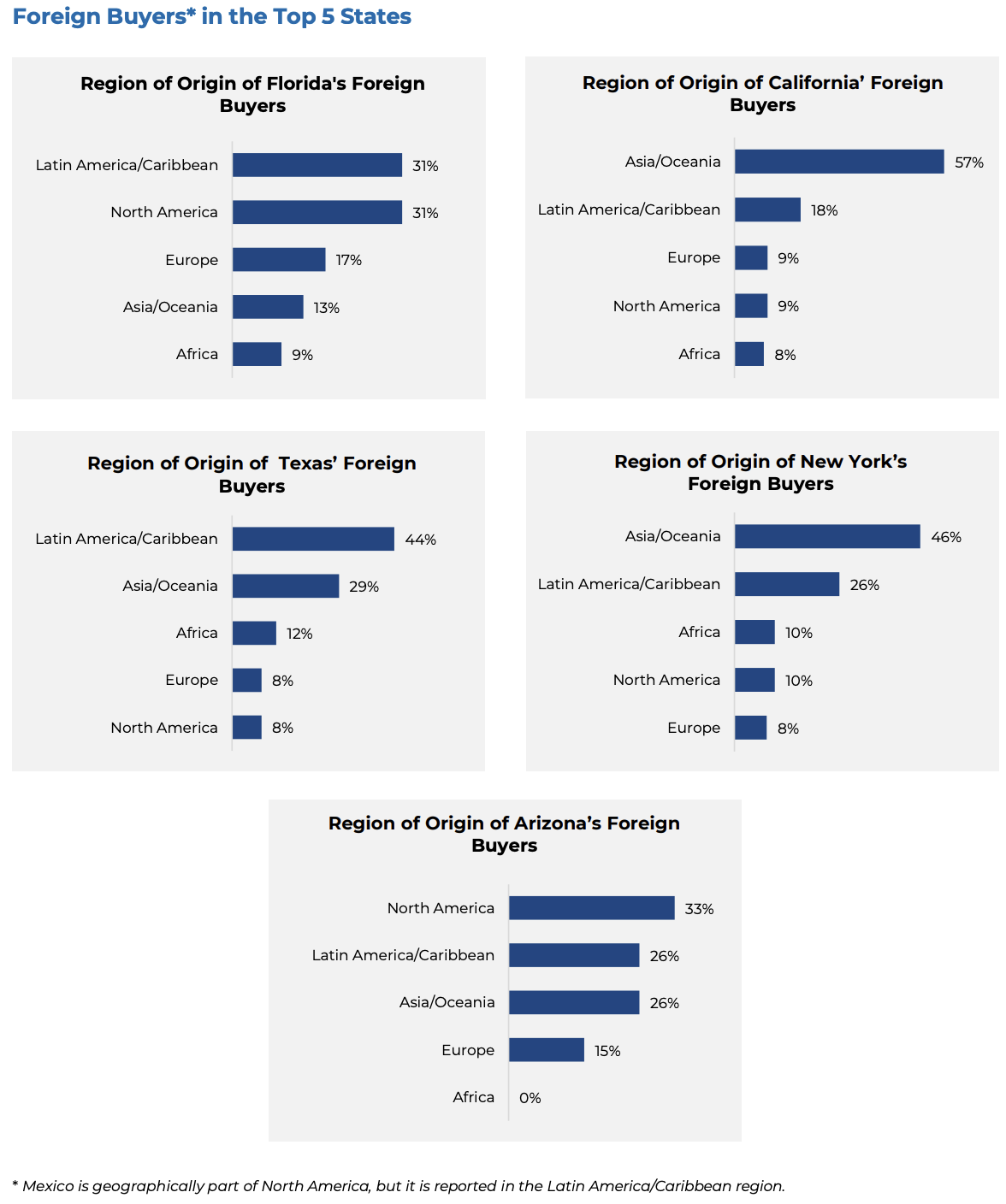
Florida continued to be the top destination for foreign buyers in the last 12 months, as it has been for the last several years, with 21 percent of all foreign buyers purchasing property in the state. The majority of those buyers originate from Latin America (31 percent) and Canada (31 percent).
Interest from Chinese buyers largely drove California to become the second-most invested-in state among foreign buyers, NAR’s report said, with 57 percent of foreign buyers in the state originating from Asia-Oceania. Meanwhile, 44 percent of foreign buyers in Texas came from Latin America and the Caribbean and 29 percent were from Asia-Oceania.
NAR’s data for this report was pulled from April 2024 to March 2025, but Golan said more recent data from clients who use the Waltz platform to apply for a mortgage loan, for instance, shows further illuminating trends on buyers from other countries with high intent to buy in the U.S., but may not quite make it into the top 10.

Yuval Golan | Waltz
“We see, for example, Israelis and Canadians with heavy interest and loan applications in Ohio, Pennsylvania and other states not mentioned [in NAR’s report] because either the numbers are, for them, too small to look at because they’re not the top 10 states, but they’re the 11th, etc … but we see all the data in real time, that Brazilians are in Florida, that Mexicans are in Florida and in Texas,” Golan said. “Israelis look, as I said, in Pennsylvania and Ohio because they’re investors and investors with high returns look for places where the purchase price is lower and the rent, comparatively, is higher.”
“If you look at the numbers, I think the UAE is also back strong investing in the U.S.,” Golan added, “which is interesting because the economy there has been strong during COVID and since [then].”
Russian buyers have also seen a significant boost of interest in U.S. real estate, according to a recent report, and more foreign buyers globally are expected to be attracted to real estate purchases in America by President Trump’s “Gold Card” visa, which is poised to create a path to citizenship for individuals who invest $5 million in the U.S.
Credit: National Association of Realtors
Top US migration destinations
- Florida: 21 percent
- California: 15 percent
- Texas: 10 percent
- New York: 7 percent
- Arizona: 5 percent
Correction: Chinese buyers accounted for 11,700 home purchases in the U.S. during NAR’s report period, not 111,700 home purchases, as stated in an earlier version of this story.
Get Inman’s Luxury Lens Newsletter delivered right to your inbox. A weekly deep dive into the biggest news in the world of high-end real estate delivered every Friday. Click here to subscribe.


