


Bigger. Better. Bolder. Inman Connect is heading to San Diego. Join thousands of real estate pros, connect with the Inman Community, and gain insights from hundreds of leading minds shaping the industry. If you’re ready to grow your business and invest in yourself, this is where you need to be. Go BIG in San Diego!
The National Association of Realtors is not considering changes to its hate speech policy due to President Donald Trump’s stance against diversity, equity and inclusion, but rather to mitigate its own legal risk, NAR President Kevin Sears told attendees at NAR’s midyear conference Sunday morning.
Sears and NAR CEO Nykia Wright kicked off a session called “The Leadership Scoop” at the Realtors Legislative Meetings in Washington D.C. Thousands of NAR’s most involved members drop in on the nation’s capital once a year to lobby lawmakers on homeownership issues.
TAKE THE INMAN INTEL SURVEY FOR MAY
But in their leadership update, Sears and Wright focused on internal NAR happenings, including the latest on potential changes to the Realtor Code of Ethics and a $32 million drop in revenue expected from a membership drop to 1.2 million in 2026.
“I want you to know that the [ethics] recommendation has nothing to do with who is sitting in the White House,” Sears told the ballroom of attendees Sunday.
NAR is considering changing its hate speech policy, called Standard of Practice 10-5, which prohibits Realtors from using “harassing speech, hate speech, epithets, or slurs based on race, color, religion, sex, disability, familial status, national origin, sexual orientation or gender identity.”
The policy, which was approved in 2020, applies to all of a Realtor’s activities, not just those related to real estate. A Realtor that violates the policy is charged under Article 10 of the Code of Ethics, which prohibits denying equal professional services to anyone in those protected classes.
One proposed change would include creating a more specific definition for what counts as “harassment” that aligns with the NAR Member Code of Conduct, which contains extensive examples of prohibited behavior.
Another would be to change the policy’s applicability so that Realtors would be encouraged, but not required, to follow the policy “in all of their activities.” Disciplinary action would be reserved for violations that took place while Realtors were acting in a business capacity.
NAR’s Professional Standards Committee will consider the proposed changes at its next meeting on Tues. June 3 and, if approved, the proposals will be considered by NAR’s board of directors at their meeting on Thurs. June 5.
According to Sears, the proposed changes aren’t a reaction to Trump but rather are years in the making. NAR began hearing from some local Realtor associations in 2023 complaining about the ambiguity in some of the wording in the policy, he said.
“We’ve got 1,100 local associations, which means we could have 1,100 different interpretations of the rule,” Sears said.
Sears joked that NAR had “some other stuff going on” in 2023 — likely a reference to the Sitzer | Burnett trial that NAR lost and led to a $418 million antitrust settlement in March 2023. Later that year, Wright hired outside counsel to conduct a legal risk assessment of NAR’s current rules and policies, including its ethics code.
“We were already aware of some issues that were percolating because of Standard of Practice 10-5 and because of that, last summer, we began the conversation about ‘Okay, well, what do we need to do in order to help solve the problem [and] remove some liability, not only for our local associations, but for our volunteer leaders?’” Sears said.
Wright chimed in with a note on DEI.
“For some reason, around the country, there’s a rumor that I have single-handedly dismantled DEI,” Wright said, prompting some chuckles in the audience.
“I don’t know if people see my complexion and recognize me as a woman,” she added, prompting more laughter.
“But that could not be further from the truth. What we are continuing to do internally is make sure that we have the best-in-class staff to get us through today’s transactions and tomorrow’s transactions.” The crowd applauded.
According to Wright, NAR’s advocacy team “over the past several years has really ramped up a significant part of fair housing,” a law that she stressed predates 2020 and the death of George Floyd, which prompted many companies to commit to boosting their DEI efforts.
“[Fair housing] is what all of the alliance groups are coming to us and saying that they want more of, just in a different sort of nomenclature,” Wright said.
She said she wanted to be “very clear about that,” especially in light of NAR’s diminished financial circumstances.
“Yesterday, when NAR had a lot of money, we were a lot of things to a lot of people,” Wright said.
“What we have to do right now is pick our bets. When you look at the fact that we balanced the budget for the first time in the last 10 to 15 years last year, and when you look at what we are trying to do next year, there is a possibility that we have to pull another $32 million out of the budget.
“Kevin has always said that everything has to be affected in terms of an equitable fashion, but we’re not going to cripple anything,” Wright continued.
“Fair housing, DEI, has not been crippled. We are just trying to be more strategic and talk to stakeholders and understanding how we are placing our bets.”
“I feel bad about how people think that we have dismantled DEI,” she added.
She also emphasized that people are asking NAR for more transparency in how the association spends its money.
“So all of our transactions, all of our sponsorships, all of our ability to hand out member money, must have a better form of accountability and transparency in how we are spending those dollars,” Wright said.
Wright pointed out that NAR had hired a consulting firm, Slalom, to survey more than 75,000 members about what they wanted post-settlement and also to help NAR’s Strategic Planning Committee.
“People have been doing strategic planning work over the last few years, and at the committee, they’ve been doing great work, but it has not been tethered to the organization,” Wright said.
“It’s been disjointed. You would see a strategic plan online, but no one internally was marching towards those efforts.
“So right now, we are bringing those together, and they were actually on site yesterday, doing really incredible work, and will be here throughout the rest of the week to help us better understand our purpose.”
She also highlighted the addition of Jarrod Grasso as NAR’s first-ever senior vice president of industry relations as “so significant that it cannot be overstated” and that he and his team are in charge of breaking down “silos” internally at the trade group.
“Yes, you can say that we are strong in advocacy,” Wright said.
“Yes, you can say that we are strong in research. Yes, you can say that we are getting stronger in education and training. But you should also be able to not just cherry-pick specific aspects of the business, but understand how NAR brings the entire house to the transaction to help people go forward.”
Some in the crowd yelled “Yeah! Yeah!” in agreement.
Wright continued. “We are and should be the base camp of the industry. Regardless of what company you work for, at the end of the day, you should always be able to come back to NAR and understand how you can move to your next company, how you can move to the next tier in terms of profitability, how you can start your own brokerage… That is the true North.”
Wright noted that NAR has a new general counsel, Jon Waclawski, who is leading NAR’s effort towards “de-risking the portfolio” and said she wanted NAR to be “the first voice” to talk about what NAR is doing.
“You should be able to come to NAR to understand what the de-risking of the portfolio is, not listening to chatter out there, swapping ignorance on social media, but understanding exactly what we are doing,” Wright said.
Her comments spurred applause and laughter. One woman in the crowd declared, “She’s a badass.”
Regarding 2026’s expected revenue shortfall, Sears noted that for 2025, NAR had budgeted for fewer members — 1.4 million — and had cut nearly $20 million in expenses this year to account for that. For 2026, NAR expects “continued contraction on membership” and is therefore budgeting for 1.2 million members, according to Sears.
Since that means trimming an additional $32 million from the budget, Sears said the leadership team asked NAR’s staff to conduct a similar process to last year where cuts would “hurt us all equally.”
“We need to be able to maintain the products and tools and services and especially the advocacy that we’ve all come to expect, and I believe that in the budget that we’re presenting to the board on Thursday, you will see that,” Sears said.
Sears emphasized that NAR will not be raising dues after hearing from large brokerages who were left out of the antitrust settlement.
“Unfortunately, as part of the settlement, there was a carve-out of approximately 92 or 96 brokerages, and so they’ve had to negotiate their own settlement, and rightfully so, they’re upset now,” Sears said.
“We broke their trust overnight, and now we have slowly trying to rebuild it. One thing we heard loud and clear is: ‘Don’t increase dues. We can’t do it on our end. You shouldn’t do it on your end.’”
Consequently, NAR will instead take about $10 per member from its $45 per member special assessment for its consumer ad campaign to fund its budget and make sure that NAR can make its next, $72 million settlement payment by February 24, 2026, Sears and Wright said.
NAR can do this because at NAR’s annual conference last November, the NAR Executive Committee approved a motion that advocacy and consumer advertising campaign reserves “be used to fund NAR’s settlement obligations … and that the board designation for these funds be suspended for the duration of the settlement period.”
Wright also noted that at least 22 state Realtor associations around the country have their own consumer ad campaign budgets.
“So what we should be doing is leveraging the three-way agreement and working together to make sure … we are managing that at the local level, and that we are able to provide resources where we need them to be,” Wright said.
Inman has asked NAR for its current membership count and will update this story if and when a response is received.
The session ended with a brief presentation from Grasso on rebuilding relationships with local and state associations, the value of the three-way agreement, and the value of the Realtor brand. He displayed graphics NAR had created in the past week to illustrate that value.
Jarrod Grasso at “The Leadership Scoop” session at the Realtors Legislative Meetings in Washington D.C. on June 1, 2025
“Local associations: They are the boots on the ground. They’re the main point of contact. They are the foundation of our organization, and I wanted to make sure that I emphasize key components of what they do to bring value to the membership,” Grasso said.
“State associations back up those local associations, provide enhanced value, but also have strategic partnerships when it comes to our lobbying efforts on specific state issues.”
“The National Association of Realtors: We bring more value and connect all three levels,” he continued.
“We’ve got [NAR Chief Advocacy Officer] Shannon McGahn and her amazing team and the work that you’re going to do today and this week up on the Hill, making sure that we emphasize the issues that are impacting us.”
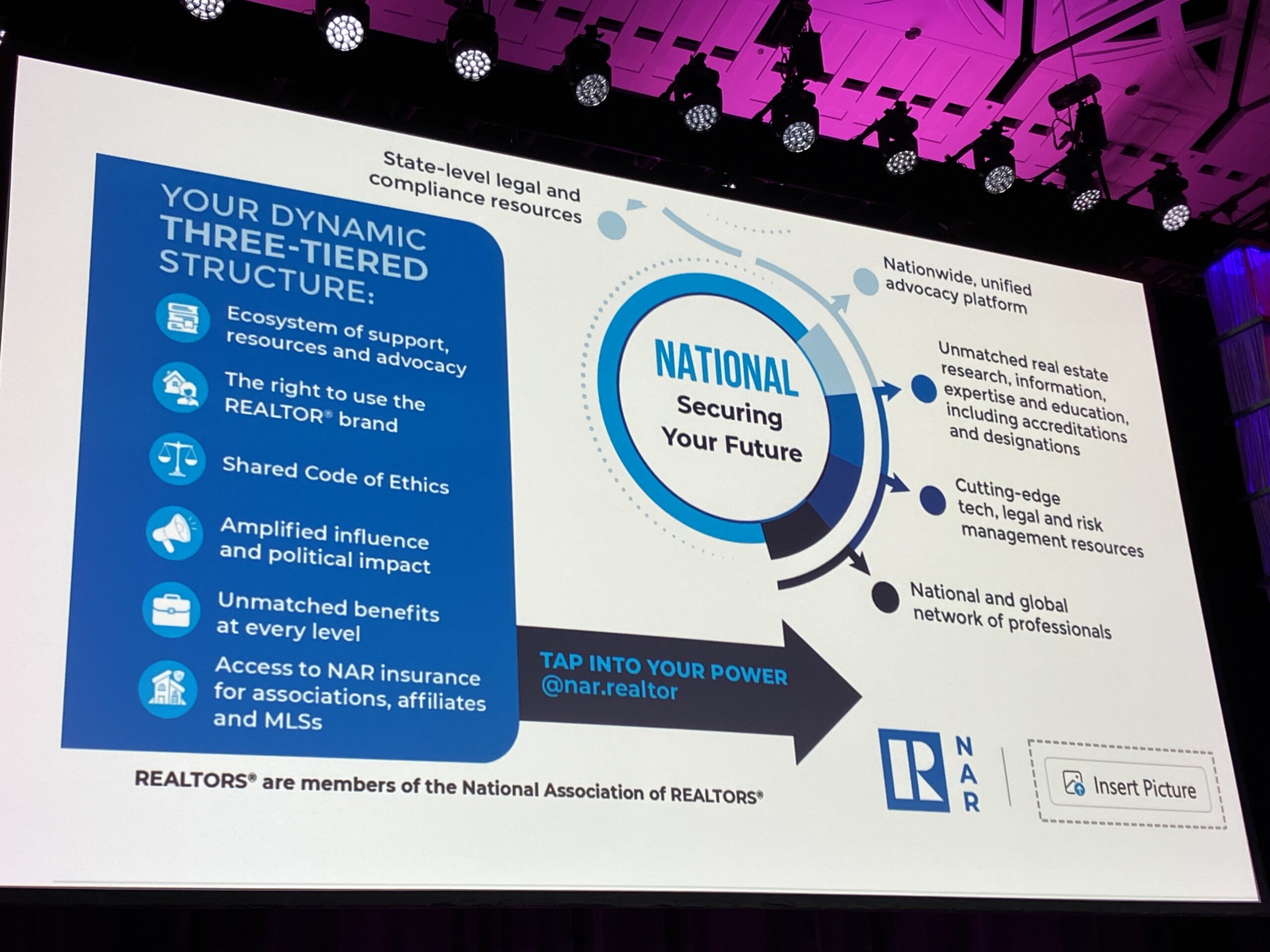
Graphic presented by Jarrod Grasso at “The Leadership Scoop” session at the Realtors Legislative Meetings in Washington D.C. on June 1, 2025
“The three way agreement is a true value,” he added.
“It’s part of the ecosystem. It’s what we bring to the members, and it’s a unique value that no other industry truly has.”


